Taming the Bass: How Auralex Bass Traps Save Your Surround Sound

Updated: May 7
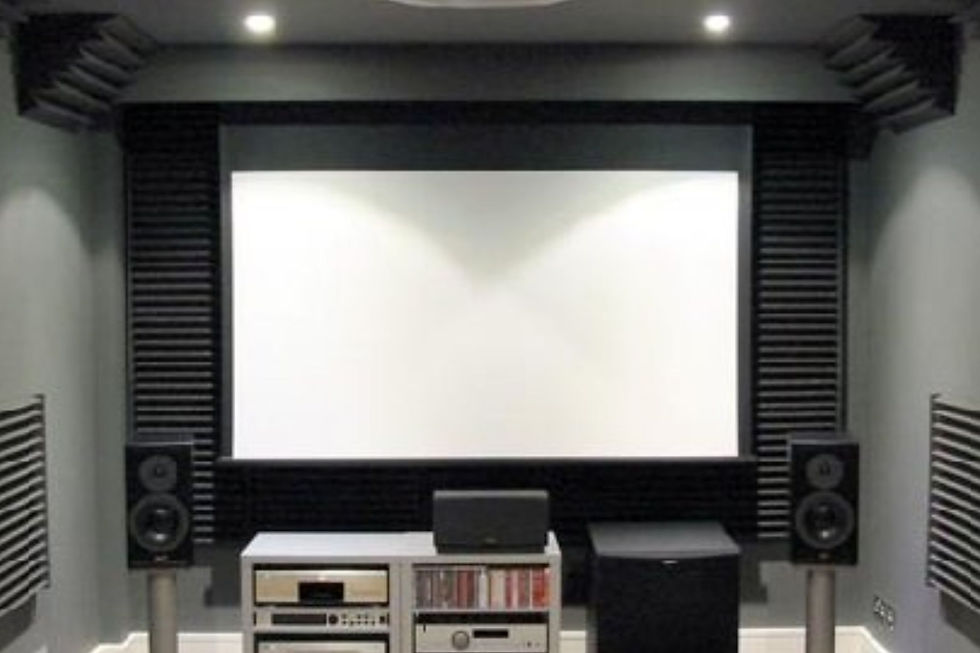
For many audio enthusiasts, achieving powerful bass is easy. Achieving accurate bass is much harder.
You may invest in premium speakers, subwoofers, amplifiers, and room calibration software, only to discover that the low end still sounds bloated, muddy, or uneven. In one part of the room the bass may feel overwhelming, while a few feet away it nearly disappears.
The culprit is rarely the equipment itself. More often, the issue lies in the physics of low-frequency sound interaction within enclosed spaces.
Low-frequency energy behaves very differently from midrange and high-frequency sound. Because bass wavelengths are extremely long and difficult to control, they tend to accumulate in room boundaries and especially in corners, where pressure buildup becomes most severe.
This is where properly designed corner-mounted bass traps, such as those manufactured by the brand Auralex, play a critical role. These acoustic treatments help absorb and manage problematic low-frequency energy, dramatically improving bass definition, impact, and overall listening accuracy.
Understanding Low-Frequency Sound Behavior
Why Bass Waves Behave Differently
Low-frequency sound waves are physically large compared to the dimensions of most residential rooms.
For example:
A 100 Hz wave is approximately 11 feet long
A 40 Hz wave stretches nearly 28 feet
A 20 Hz wave can exceed 56 feet in length
Because these wavelengths are so long, bass energy does not simply travel directly from the speaker to the listener. Instead, it interacts extensively with the room itself.
As bass waves strike walls, ceilings, and floors, they reflect repeatedly throughout the space. These reflections combine with incoming waves, creating zones of reinforcement and cancellation.
The result is highly uneven bass response.
Why Bass Accumulates in Corners
Boundary Reinforcement
Every room surface acts as an acoustic boundary.
When bass frequencies encounter a wall, part of the sound energy reflects back into the room. When multiple boundaries intersect, such as where two walls meet or where walls meet the ceiling, low-frequency pressure increases significantly.
Corners represent the highest-pressure zones in most rooms because they combine:
Three-dimensional boundary interaction
Multiple reflection paths
Concentrated standing-wave energy
This phenomenon is known as boundary reinforcement.
The more boundaries bass energy encounters simultaneously, the stronger the low-frequency buildup becomes.
The Science of Room Modes and Resonance
Modal Resonances Explained
One of the most important acoustic concepts in small-room audio is the formation of room modes, also called standing waves.
A standing wave occurs when reflected bass frequencies align with incoming waves at specific room dimensions.
This creates:
Peaks where frequencies become exaggerated
Nulls where frequencies cancel out
Extended decay times known as modal ringing
These resonances are responsible for the familiar symptoms of poor room acoustics:
Boomy bass
Muddy low end
One-note bass response
Weak transient impact
Inconsistent bass throughout the room
Different room dimensions support different modal frequencies, which is why some rooms naturally exaggerate certain bass notes more than others.
Modal Ringing
Low-frequency energy also decays more slowly than higher frequencies.
Without proper treatment, bass notes continue resonating in the room after the original signal has stopped. This lingering energy smears timing information and reduces clarity.
Instead of hearing clean bass articulation, listeners experience overlapping low-frequency energy that masks detail and precision.
How Corner Bass Traps Work
The Purpose of Bass Trapping
Bass traps are specialized acoustic treatments designed specifically to manage low-frequency energy.
Unlike thin acoustic foam intended primarily for midrange and treble absorption, true bass traps are engineered to interact with longer wavelengths and pressure zones.
Corner-mounted traps are especially effective because they target the areas where bass pressure naturally accumulates most intensely.
The Acoustic Design of Auralex Corner Bass Traps
Auralex corner traps are designed using acoustically absorptive materials and geometric structures that maximize low-frequency interaction.
Their functionality relies on several principles:
Porous Absorption
The material structure converts acoustic energy into minute amounts of heat through friction as air particles move through the trap.
This reduces reflected low-frequency energy and shortens bass decay times.
Increased Surface Interaction
Corner-mounted designs expose more surface area to concentrated pressure zones, improving efficiency where bass accumulation is strongest.
Partial Diffusion
Some trap geometries also scatter portions of mid and upper bass energy, helping preserve room liveliness while reducing problematic resonances.
Together, these mechanisms reduce standing-wave intensity and smooth low-frequency response throughout the listening space.
The Audible Benefits of Corner Bass Trapping
Tighter, More Controlled Bass
One of the most immediate improvements listeners notice is tighter bass response.
Instead of bass notes blending together, individual notes become more distinct and articulate.
Kick drums gain definition.Bass guitars sound more textured.Electronic low end feels cleaner and more precise.
Improved Punch and Impact
Contrary to popular misconception, bass traps do not remove bass, they improve its accuracy.
By reducing modal ringing and excess buildup, transient energy becomes more immediate and impactful.
Listeners often describe the result as:
Faster bass
Stronger punch
Better slam
Increased tactile sensation
The bass becomes something you not only hear, but physically feel with greater precision and control.
Enhanced Clarity Across the Entire Frequency Spectrum
Low-frequency problems affect more than bass alone.
Excessive bass buildup masks important midrange detail through a psychoacoustic effect called frequency masking.
Once low-end resonances are controlled:
Vocals become clearer
Stereo imaging improves
Dialogue intelligibility increases
Instrument separation becomes more apparent
The entire soundstage gains transparency.
Optimal Placement for Corner Bass Traps
Start with Vertical Corners
The most effective placement for bass traps is typically:
Front vertical corners behind the speakers
Rear vertical corners behind the listening position
These locations contain strong low-frequency pressure buildup and yield significant acoustic improvement.
Floor-to-Ceiling Coverage
In serious listening environments, stacking traps from floor to ceiling provides maximum broadband low-frequency control.
More surface area generally equals more effective bass absorption.
Ceiling-Wall Junctions
In rooms where floor space is limited, installing traps along ceiling-wall boundaries can also provide substantial low-frequency management.
These areas are often overlooked but contain strong modal activity.
Symmetry Matters
For stereo listening rooms and home theaters, symmetrical placement helps maintain balanced imaging and consistent frequency response between left and right channels.
Integrating Bass Traps into Different Room Types
Home Theaters
Home theater systems generate substantial low-frequency energy, particularly with dedicated subwoofers.
Corner bass traps help:
Improve cinematic impact
Tighten LFE performance
Reduce room boominess
Enhance dialogue clarity
Two-Channel Listening Rooms
Audiophile stereo systems benefit enormously from improved low-frequency linearity.
Bass trapping enhances:
Soundstage depth
Instrument separation
Tonal balance
Many listeners chase better sound by upgrading electronics or purchasing larger speakers.
Yet untreated room acoustics often remain the largest limiting factor in system performance.
Even exceptional speakers cannot overcome severe modal problems in an untreated room.
Acoustic treatment frequently delivers greater audible improvement per dollar than upgrading hardware alone.
The room is not separate from the audio system, it is an active acoustic component of the system itself.
A Trusted Resource for Acoustic Treatment Solutions
For homeowners, audiophiles, and professionals seeking high-performance acoustic treatment products, Quality Home Technologies offers solutions tailored for:
Dedicated listening rooms
Home theaters
Recording studios
Media rooms
Professional audio environments
Their range of acoustic treatment options, including bass management products and room optimization solutions, can help transform problematic listening spaces into acoustically balanced environments.
Conclusion
Low-frequency acoustics are among the most challenging aspects of room design and audio reproduction. Because bass waves are long, powerful, and highly interactive with enclosed spaces, they naturally accumulate in room corners and create uneven, resonant low-frequency behavior.
This buildup leads to the familiar problems of muddy, boomy, and poorly defined bass that diminish overall audio quality.
Corner-mounted bass traps from Auralex address these issues by absorbing and managing concentrated low-frequency energy where it accumulates most intensely. The result is tighter bass, improved transient impact, enhanced clarity, and a more immersive listening experience.
Ultimately, exceptional sound reproduction depends not only on the quality of the equipment, but also on how effectively the room itself is controlled. By understanding and treating low-frequency behavior, listeners can unlock the full potential of their audio systems and experience bass with greater depth, precision, and emotional impact.


Comments